
My relationship with my hands is generally a bit uneasy. I use them to eat, to dress myself, to catheterise, to cook and clean. I’m using them right now to type! I find that I use my hands for almost everything I do short of walking, and now I use a manual wheelchair, I use them for that, too.
I used to be so good at typing. I was a medical secretary in an ulcer clinic once way back in the day, like shortly after the fall of the Byzantine empire, and I learned to type words like ‘sloughing’ really quickly. As a newly minted Educational Psychologist I’d type during consultations, fast enough to make live notes as we were talking, and all without ever looking at the keys. Being able to empathically look at someone while my hands were making subtle precise movements over the laptop keyboard, quietly taking detailed notes of our encounter, was like a psychologist superpower.
I also used my fine dexterity to paint miniatures for d&d games I was running and to digitally sculpt in Blender. This is one of my favourites: Iva and Cauchy.
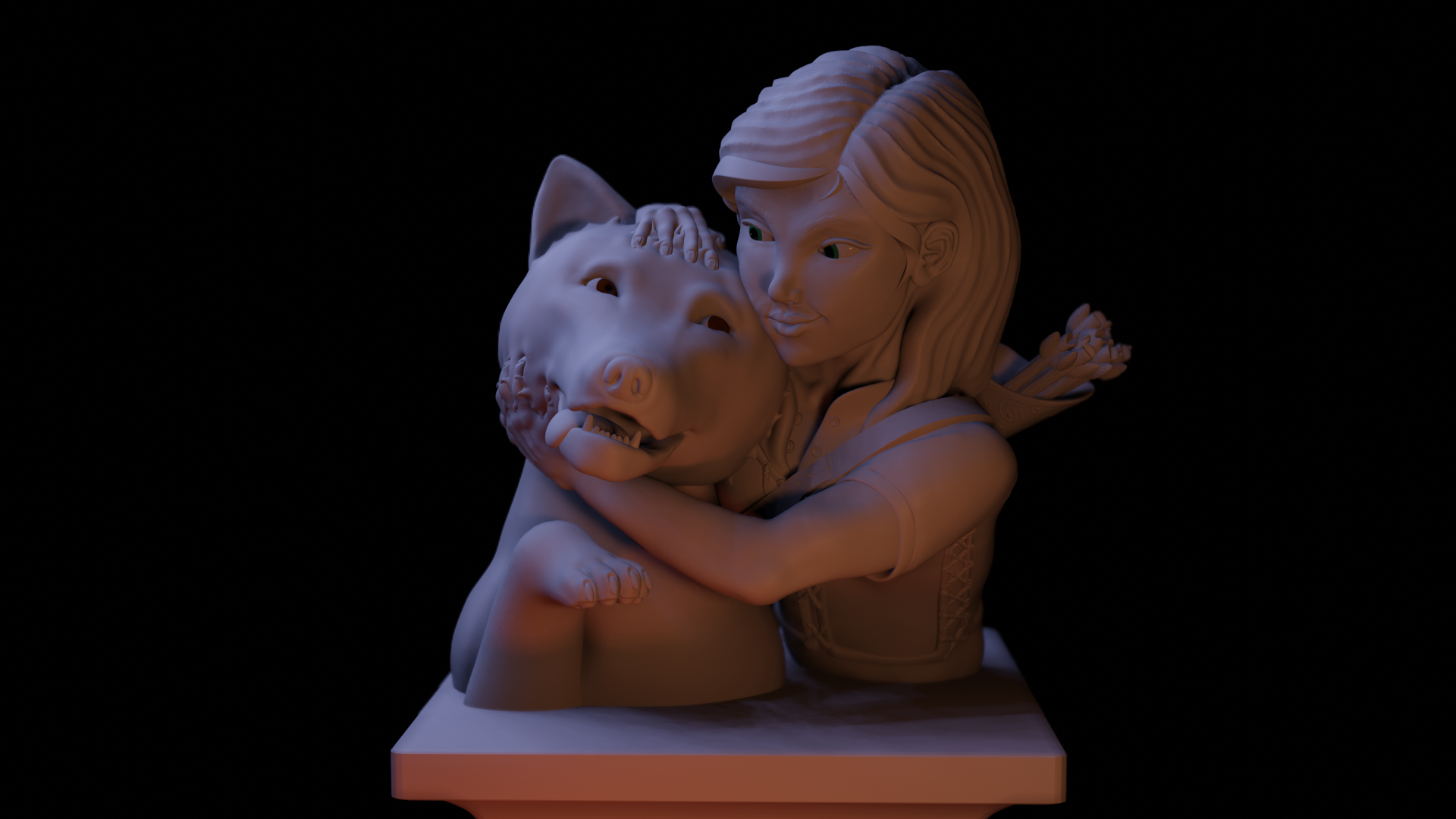
I learned to sculpt after MS began, feeling like I might need tradeable skills beyond my University work should MS begin to affect the abilities I needed to do that work well.
Ironic, really, that MS would affect the skills I used to sculpt, first.
My hands started to become threatened when I had one of my many major relapses. I went numb on one hip and over weeks the numbness spread to encompass my whole body from my collarbone down. As it spread down my arm I remember wishing with all my power that it wouldn’t affect my fine motor control.
Whenever I relapse I message my MS team to plead for some action we can take, some foe we can actively fight. ‘You tell me to push 100km I will go plan a route, you tell me to climb Ben Nevis I will go find a team, you tell me to learn to breakdance and I will go buy a fashionable beanie, just tell me what to do…’ They know I’m serious, I’ve bought beanies before, and they tell me that what I am already doing is all there is. Eat well, prioritise sleep, rest when you need to, exercise regularly. Even steroids, designed to bring the relapse to an end quicker, do not change the amount or type of damage you sustain. They cannot change the outcome.
What a relapse takes, how much it robs from you, is all down to a roll of fate’s dice.
At this point, mid-relapse, my body quickly numbing like I was standing underclothed in a meat locker, it somehow still looked to me like the dice hadn’t yet tumbled and that maybe I could nudge the table, somehow manifest protection for my hands through sheer force of will. I tried bargaining even, maybe the fates would accept me keeping my hands if I willingly gave up my legs. But these are fate’s dice. They roll to whatever end has already been determined.
The numbness spread into my hand.
I quickly lost control over my left hand. I lost the ability to type, to play videogames with a controller, to do up buttons, to manipulate a fork. Even driving started to become awkward when passengers periodically found me attempitng to shift their right knee into second gear. The controller was, oddly, the most surprising. The thumb rests on the stick and pushes gently in a direction to move the character, such a simple action, but I couldn’t feel the stick beneath my thumb, and the pressure was painful against it. Even simple games were impossible to play with that hand.
My friends were there for me, buying me a mouse that could do the left hand’s work with fingers of the right, looking to the use of one-handed keyboards to type. With their help I started to find solutions to problems fairly quickly with the use of my right hand being fairly strong.
I’ve faced a good many of these moments with Multiple Sclerosis, where something critical is threatened. Chronic pain, insomnia, bladder and mobility dysfunction, all upended my life overnight. You grieve, you work the problem, you adapt, and somehow you find a way to continue.
Even when the relapse has stopped getting worse and has started to recede, you are still left in the awful position of being unable to predict which of the abilities that have been stolen will be returned to you. The chance of recovery is another roll of fate’s dice. There’s no telling if, when, or how much function you will regain. And again there is nothing you can do to affect the outcome.
But I know that hope is precious. Even in a land where hope is forsaken we must somehow find it within ourselves to hope. So when my hands became numb enough to fumble putting on socks I reached for that glimmer of possibility that things might yet improve, set my mind to it, and got to work solving problems and pushing to that outcome, believing it was possible, while fate’s dice were still in the air.
I remember talking with a friend who told me that my hope, my prediction that my hand would recover, was a good psychological trick, something we tell ourselves to make the inevitable decline easier to bear. He was right. But he was also wrong. The outcome cannot be changed, but we do not know what it will yet become. This is the challenge of MS fundamentally, the decline is to some extent inevitable, it is a degenerative disease. But the outcomes are so varied, so diverse, that there remains always the possibility of a better fate than we might fear. Hope is forsaken in this land. But that is why we must nurture a candle to hope within ourselves. Because if we do not nurture it the darkness all around will consume it, consume us.
‘What’s the alternative?!’ I blurted out. ‘Give up??’
That part of me that steels herself in these moments was close at hand, in my ear, sword drawn. If I looked like there was a chance I might give up, she wouldn’t let us.
Beyond her defiance, this is a story of the moment before the fall. If the fall is inevitable, if a tragic fate does await us in mere seconds, then it is only the short time we have before the dice hit the table to truly live. We cannot change the roll. But we can change our experience of that moment the dice are in the air. Hope, love, defiance, are the watchwords of a last stand.
It took 6 months for power to return to that hand. But it did return. I’d like to say that my defiance was effective, that somehow I had such strength of will that I forced power back through my fingers like a wizard commanding a cloud to rain. In truth nothing I did really changed this outcome. I got lucky.
Then the numbness spread to the other hand.
Like a cruel game of cat and mouse my immune system was chasing my skills around my body, impeding them indiscriminately. But with time, tears, and forced patience, the feeling returned to my right hand.
I remember the moment. I was in bed, on my way to sleep, when I realised that I could feel the bedcovers over the back of my hand. Something so casual, so habitual, that I had lost for so long… it felt like a breath of magic and all the hairs on the back of my arms stood up, reaching for the novel sensation.
And now here I am, all defiance and fury typing against the odds. I recovered the use of my left hand and my right, and as long as it is cold I can use both hands pretty effectively. When it is hot, when I’ve been using my hands, or after eating, I lose some of the strength and dexterity once more. My thumbs inadvertently descend onto the spacebar, injecting gaps in my writing like literary lesions. My fingers will wander off like lost children and when it is time to tap a key they’re somewhere unhelpful, like in the ear of a neighbour. It’s not going to be long before I discover that my pinkie has bought a ticket to Scarborough and I find her at the bus stop.
My life hasn’t changed. I have changed. Again. And now I must reforge my life once more, with new techniques, new tools, renewed resolve, and find that depth of will somewhere within myself from which to draw to carve out my life from the destruction MS havocs upon it.
While hanging up towels today, my leg buckled out of nowhere. It just stopped holding me up. I rapidly descended and barely caught myself on that leg, power enough to catch me moments before impact with the ground. What happened, why then, whether this is a relapse or a freak neurological blip, who can say.
These moments have become remnants of what are now traumatic memories, and they always give me pause. That vigilant part of myself, clutches at the hilt of her sword, ready to do battle with the next relapse. But if it is not a relapse then I need to steady her blade. I cannot find peace in the shadow of her vigil.
So I stop and breathe. I test my legs. I find my resolve. Not only to fight against the disease and the limitations it imposes, but to cherish the moments of peace between attacks.
Today I wheeled out in my wheelchair, having hurt my back doing something as woefully treacherous as topping up her tyres. I find it hard to walk, but the Rocinante will carry me, and I need to become strong. A lady approaches me on the bridge as I’m trying to get myself back into the chair, lifting my bag-of-wet-socks legs back into position by hand. She stops briefly to tell me that she’s seen me around, wheeling fast past her house somewhere nearby. She smiles. I smile back. I say something inane so that I don’t cry at her kindness.
My back twangs pain and my legs spasm in response. I look at the path ahead, the long sweeping road downhill.
Somewhere, I hear fate scrape dice from the table. But so do I. Fate might roll for my future. I roll for initiative.