
Last year I climbed one of the most challenging hills I’ve ever attempted in a wheelchair: Baggy Point in Devon. Narrow dirt paths on a cliffside route in the rain created an ultimately insurmountable challenge. The slippery path became so narrow and steep that my wheels would spin with each push threatening to slide me down the cliffside mere feet to my left. I had to turn back 50 metres from the summit. I still very nearly fell into the ocean.
I have also been building my strength. My legs can now carry me for much further before slipping into gelatinous failure. I still need my wheelchair, the Rocinante, for long distances, but when the terrain becomes challenging I can get out of the chair to push her further before faltering. And with my arms so much stronger than they once were I can trek for 10k without too much difficulty. In fact the main barrier to longer routes is now not my strength or stamina but my bladder’s hair trigger that threatens me periodically whenever I’m too warm. The urologist has agreed to see me at his earliest convenience… in 7 months.
The question now is to where I might use my new strength to trek. Having pondered my options I have decided to go and see the sights of England from high up places, journeying in my wheelchair and pushing to the summits to see the views, take selfies (I am a millennial… barely), meet people, and be out in the world.
This week I began this series of adventures by journeying to the highest point in the very hilly city of Winchester, one that overlooks the entire city: St Catherine’s Hill. This hill has a height of 318 feet (just shy of 100 metres) and has 380 steps you can climb to reach the summit. I discovered to no one’s surprise that these steps are not wheelchair-able.
Within a few pushes along the gravel path at the base of the hill I realised just how impossible this climb would be while seated. So I stood, shook off my legs’ stiffness, and pushed the Rocinante up the side of this hill. The hill is far too steep to climb directly, especially with a chair, so I circumnavigated the hill while climbing to reduce the incline.
Through the bushes, the long grass, grinding the Rocinante uphill, I felt my legs start to buckle. This was a considerable workout for legs that rarely take such strain. But I made it very nearly to the summit. I was about 10 metres from the top when I stopped to take in the views. I realise that I didn’t quite make it all the way, and I will return to finish the job, but for now I needed to conserve enough leg power to return to the bottom of the hill.
I mean I was always going to get to the bottom of the hill, but I needed to get there without broken bones. Even with some conserved strength at one point the Rocinante went ahead of me and I caught up with her a little later in a bush.
I managed to get to my destination just in time to watch the sunset over the city. Here’s my shot from the (nearly) summit.
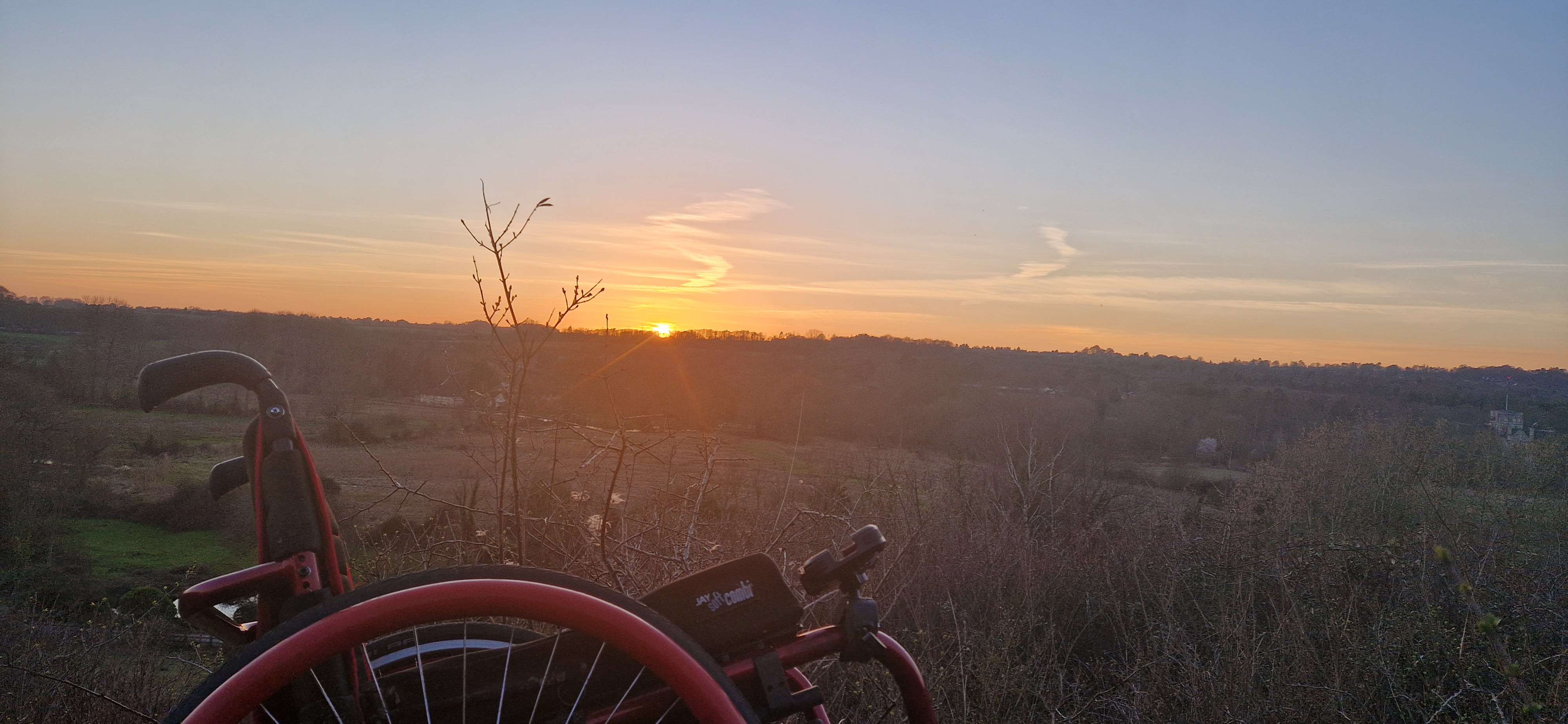
The sunset over the distant treelined horizon, Cora’s red and black manual wheelchair in the foreground.
So what did I learn from this endeavour? First: my leg strength is fundamental to the climb. I could not, even with limitless arm strength, climb this summit while seated. Even if I could manage the Sisiphian task of muscling my 100kg of mounted ass uphill the Roci would tip backward with each stride. It is possible to prevent this by turning and hauling the Roci in reverse, but without being able to see where you're going, you're as likely to wind up in the living room of a local sheep farmer as you are your destination. I think there might be a way to climb crawling with the Rocinante towed behind me by a rope around my waist, but it would be… challenging.
While climbing this hill even I was surprised at how well my legs performed and I’ll be forever grateful to my MS team for giving me the window I needed to build my body muscle. I’m on a virtuous cycle, where my strength permits greater acts of defiance, and those build greater strength. But frequent MS relapses threw me off this cycle every 18 months, for 4 years, and now that I’m not relapsing at all I can take the opportunity to become an MS fighting machine.
I also learned that considerable feats of arm strength will make your arms tired for a few days, but your arms aren’t holding up your body weight. With MS leg weakness, your legs becoming tired means you can no longer walk. For two whole days after the journey I was far more disabled than I am familiar with, being far unsteadier than I’m used to. Over those two days I had to have a great deal of trust that the weakness was due to the exertion and that not only would they improve, but they would be better than before as the muscles repaired and strengthened.
I also learned that gravity doesn’t care if your legs don’t work, it’s not giving you a day off. Coming down the hill is easy. Coming down the hill safely is virtually impossible. There were moments where I stumbled, where the uneven ground gave beneath me, and where my legs themselves couldn’t compensate for a blade of grass out of place underfoot and would collapse like paper straws. It was possible to sit, use the legs to slide my bum downhill, while holding the Roci steady in front of me, but I wouldn’t say it was particularly dignified. At one point I did let go of the Rocinante by mistake and she took off downhill without me, stopping happily in a prickly bush. I will learn.
So what is next, dear reader? Our next challenge takes us to Butser Hill in QEII Park on the South Downs Way. Standing at a height of 889 feet (271 metres) it’s nearly three times the height of St Catherine’s. If one thing is for sure it’s that this one is going to be a challenge. If two things are for sure, it’s that I’m going to wet myself on that journey.
I will falter, of that I am certain. But I will grow. I will learn. I will overcome.